














































The Annihilation of Koniuchy
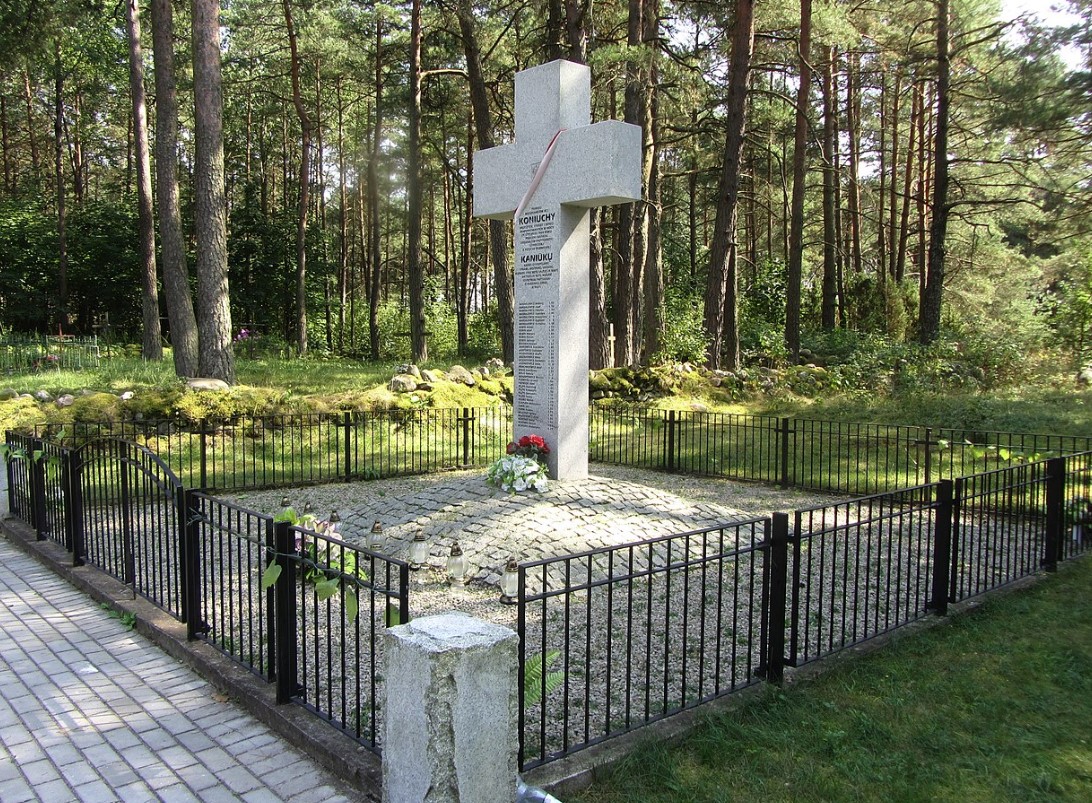
In May 2020, Poland’s Institute of National Remembrance – Commission for the Prosecution of Crimes against the Polish Nation concluded a 19-year investigation into the mass murder of civilians in the village of Koniuchy, located in the Wilno (Vilnius) region of interwar Poland. The massacre, which took some 40 lives, mostly women and children as young as two, was carried out by Soviet partisans on January 29, 1944.
Koniuchy was a village of approximately 60 buildings and over 300 inhabitants, mostly Poles, located on the edge of the Rudniki Forest (Puszcza Rudnicka). This sprawling forest was the site of many Soviet partisan bases. However, the partisans engaged in very few confrontations with the German military. Villagers did not launch suicidal operations against well-armed Soviet partisans. Rather, skirmishes broke out occasionally during the partisans’ incessant raids, often involving violence, for food, livestock, and clothing. Zalman Wylozni, a Soviet partisan, recalled, “We got food from the farmers in various ways, primarily, with the help of weapons.” According to Dov Levin, a historian who was a member of a Jewish partisan unit in the Rudniki Forest, the partisans displayed “open hate and hostility towards the local population.”

A small group of men in Koniuchy banded together in an attempt to fend off plundering, with little success. In retaliation for this act of defiance, on the night of January 28-29, 1944, Soviet partisans surrounded the village and, around 5:00 a.m., launched an attack that lasted one and a half to two hours. Torches were used to set fire to the thatched roofs of houses. Awakened, fleeing residents were shot indiscriminately. Most of the buildings were burned down, with only a few houses surviving. Some of the victims were incinerated in their homes. At least one was stoned to death. No fewer than 38 villagers were killed, with many more wounded.
The attack on Koniuchy was carried out by a 120-150-strong group of Soviet partisans, mostly Jews and Russians, from various units stationed in the Rudniki Forest. The largest contingents came from the Kaunas and Vilnius Brigades of the Lithuanian Guerrilla Movement, among them fifty to sixty participants from the Vilnius Brigade, under the operational command of Yaakov Prener (Jacob Prenner). The latter included members of four detachments composed overwhelmingly of Jewish fugitives from Wilno. According to Vitka Kempner Kovner, one of the female partisans, they were “Jewish fighting units, under Jewish commanders, in which the language spoken and orders given was Yiddish.“ The next largest group of assailants, from the Kaunas Brigade, included quite a few Jewish members of the “Death to the Occupiers” detachment, which counted some 80 fugitives from the Kaunas ghetto.
What is remarkable is that the assailants left many boastful accounts in which they identified dozens of partisans who participated in the assault. These same accounts, however, are full of concocted claims regarding the background and execution of what was portrayed as a “military operation.” Some accounts mention a pitched battle against a (non-existent) German garrison. Alternatively, Koniuchy is said to have been a well-armed, fortified settlement, with excavated trenches, guard towers, and houses full of ammunition, inhabited by Nazi collaborators who attacked and harmed Soviet partisans. Genrikas Zimanas (Henoch Ziman), who headed the partisan command in the area and oversaw the entire operation, secured permission from Moscow to obliterate the village and its inhabitants. Afterwards, he reported, “We did not have casualties on our side.“ Clearly, as intended, this was a bloodbath.
The Partisans, In Their Own Words
The accounts of Jewish partisans from the Rudniki Forest must be read with considerable caution. Rimantas Zizas, the leading Lithuanian historian on this topic, has stated authoritatively:
… the memoirs of Jewish partisans, even some authors writing about the action at Kaniūkai [Koniuchy], are extremely subjective, and they are full of figments of imagination, things that never took place (about a “fortress” installed by the self-defence guard, excavated trenches, guard towers, the results of the operation, all inhabitants killed, of which there were 300…).
Chaim Lazar, from the “Avenger” detachment of the Vilnius Brigade, wrote,
The Brigade Headquarters decided to raze Koniuchy to the ground to set an example to others. One evening a hundred and twenty of the best partisans from all the camps set out in the direction of the village. There were about 50 Jews among them, headed by Yaakov Prenner. … The order was not to leave anyone alive.
With torches prepared in advance, the partisans burned down the houses, stables, and granaries, while opening heavy fire on the houses. … Half-naked peasants jumped out of windows and sought escape. But everywhere fatal bullets awaited them. Many jumped into the river and swam towards the other side, but they too, met the same end. The mission was completed within a short while. Sixty households, numbering about 300 people, were destroyed, with no survivors.
Isaac Kowalski, from the Second Fighters’ Group of the Vilnius Brigade and editor of a Soviet partisan bulletin, stated,
Whenever our partisans crossed in groups of five or ten men to important and dangerous missions [i.e., provision raids on villages], they met with sniper fire and always suffered casualties. …
Our detachment got the order to destroy everything that was moving and burn the village [of Koniuchy] down to its roots. … The villagers and the small German garrison answered back with heavy fire, but after two hours the village with the fortified shelter was completely destroyed.
Dov Levin, from the “Death to the Occupiers” detachment of the Kaunas Brigade, published the following account.
Its inhabitants even actively attacked partisan units that passed close to the village, and tortured to death those whom they captured alive. The village itself was well fortified with defense excavations, sniper positions, and lookout towers. … At midnight the force reached the entrance to the village, and after a short battle, the partisans crushed the fierce resistance of the Koniuchy inhabitants. Many began to flee from the village, but they were destroyed by ambush units. Following the battle, the entire village was set afire. … outstanding fighters were David Tepper, Ya’akov (Yankel) Ratner, Pesach Wolbe, Lazer Zodikov, Leib Zeitzev, and other fighters from Kovno [Kaunas] ghetto who were the first to storm the village.
Abraham Zeleznikow, from the “Struggle” unit of the Vilnius Brigade, recalled,
Partisans came around the village, everything was torched, every animal, every person was killed. And one of my friends, acquaintances, a partisan, took a woman, put her head on a stone, and killed her with a stone.
Paul (Pol) Bagriansky, from the Vilnius Brigade, recalled,
I was appointed by our commanding officer as interpreter and messenger between various units. … I understood that our purpose is to destroy the entire village including all the villagers. … Some units had the task of setting the huts on fire while the others had to close the escape routes. … The explosions from fire of all the thousands of German bullets that were held in each hut, the terrible noises of the burning animals and the shooting of the escaping villagers made such a hell of an uproar that no human cry or voice could be heard. … When I reached my unit I saw one of our people holding the head of a middle aged woman against a big stone and hitting her head with another stone. Each blow was accompanied by sentences like: this is for my murdered mother, this is for my killed father, this is for my dead brother, etc.
When I reached the unit to tell them their new assignment, I saw an awful, gruesome picture. … In a small clearing in the forest six bodies of women of various ages and two bodies of men were lying around in a half circle. All bodies were undressed and lying on their backs. The full moon was shining on them. One man at a time was shooting in between the legs of the dead bodies. When the bullet would strike the nerve the body would react as if were alive. It would shiver, quiver for a few seconds. The women’s bodies reacted much more violently than the dead bodies of men. All men of the unit were participating in this cruel play, laughing, in a wild frenzy.
The commanding officer assembled all units, thanked them for their well accomplished job, and ordered them to be ready to start to go back to our base. The people were tired but their faces looked satisfied and happy with the accomplished assignment. Only a very few of them realized what a terrible murder had been committed within one hour. Those few looked dejected and downcast and felt guilty. … As we learned the next day, the other units got a heroes’ welcome for destroying Koniuchy and they drank and ate and sang all night. They enjoyed the killings, the destruction and most of all the drinking.
Further reading:
“Koniuchy: A Case Study” in Marek Jan Chodakiewicz, Intermarium: The Land between the Baltic and Black Seas (New Brunswick, New Jersey and London: Transaction, 2012), 500–519.