


















































How to Blame Poles for Hundreds of Victims of the Jewish Police
Piotr Gontarczyk
The “new Polish school of Holocaust research,” commonly associated with Barbara Engelking, Jan Grabowski, and their colleagues, in its various publications, systematically assigns blame to the Poles for the deaths of hundreds of Jews murdered by the Germans. It does the same with hundreds of victims who were discovered in various hiding places and handed over to the Germans by the Jewish police.
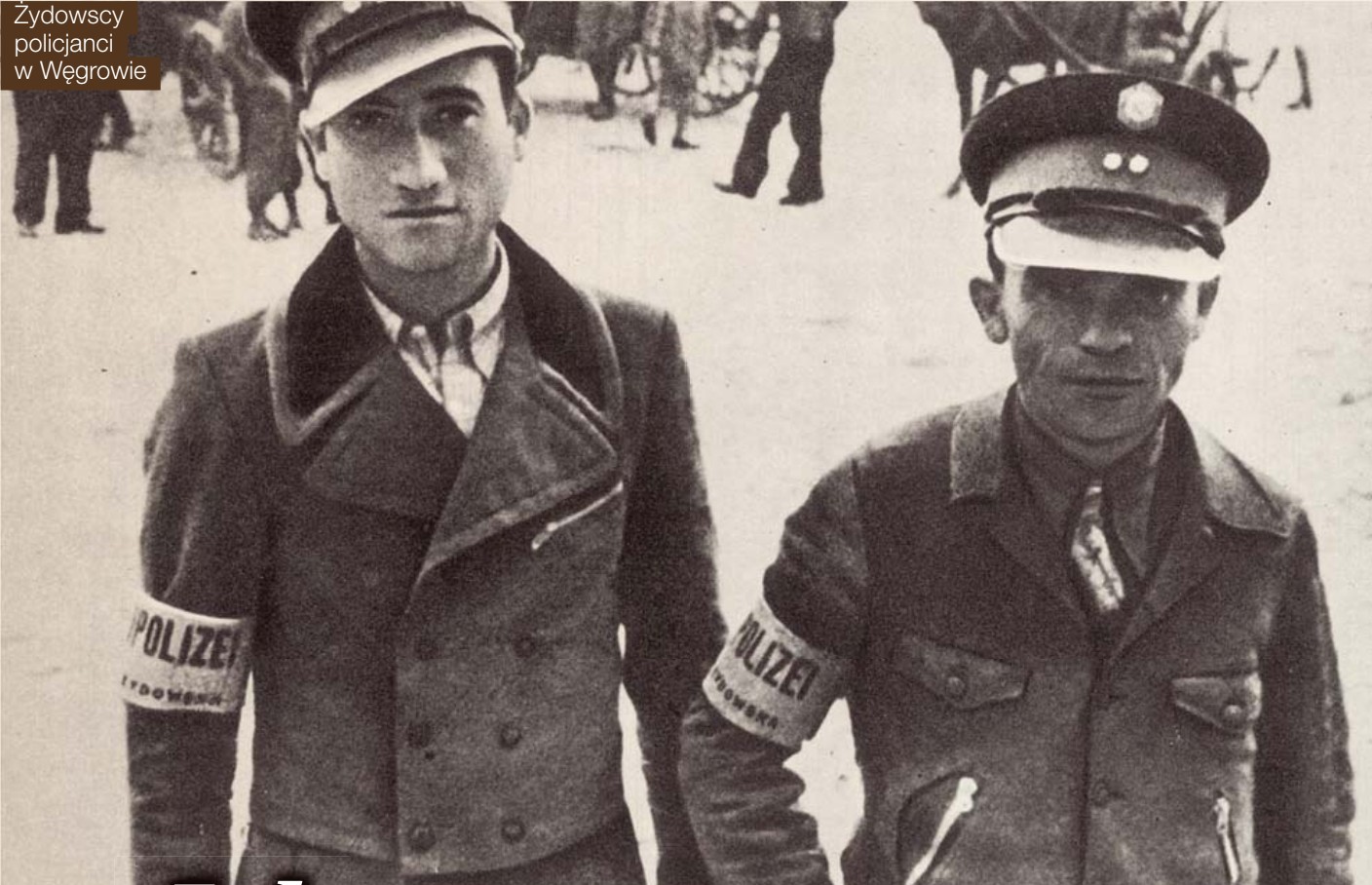
Raul Hilberg’s monumental book The Destruction of the European Jews, published in 1961, remains one of the most important works on the Holocaust to this day. It leaves no doubt that Jews serving in the Jewish Order Service (i.e., police) in various countries of German-occupied Europe were directly involved in the deportation of their fellow Jews. This is a shameful manifestation of collaboration.

The problem of describing the activities of this formation was faced by the followers of the so-called new school of Holocaust research, headed by Barbara Engelking and Jan Grabowski. The source materials they worked on while writing their articles and books, including, above all, Dalej jest noc: Losy Żydów w wybranych powiatach okupowanej Polski (Night Without End: The Fate of Jews in Selected Counties of German-Occupied Poland, 2018), contained a wealth of information on the activities of the Jewish Order Service (Jüdischer Ordnungsdienst, abbreviated as JOD or OD), about which Hilberg’s study provides just fragmentary information on this topic, while the Yad Vashem website mostly offers trivial generalities. Engelking and Grabowski are certainly familiar with them; however, one of the main goals of this “school” does not seem to be the reconstruction of history, but rather the construction of a very specific image of it.
As part of these activities, a methodological framework for distorting the content of the sources used was created, so that various groups of Poles (policemen, firefighters, village heads, and even witnesses to German crimes, referred to as “witnesses and thus participants in the extermination actions”!) were included in the circle of evil. At the end of this road is an attempt to move Poles from the group of nations that were victims of German policy to the category of “accomplices of the Holocaust.”
The perpetrators of this operation faced the problem of what to do with numerous sources on the sometimes outright criminal activities of the Jewish police, which significantly hindered the construction of a one-sided description of the attitudes of Poles and the creation of a scheme for labelling them as “accomplices of the Holocaust.” The method used in this case can probably be outlined as follows: “Keep quiet, cut it out with scissors, and what cannot be removed, blame it on the Germans, or better yet, on the Poles.”
In the weekly magazine Sieci (“On the Jewish police during the war,” September 8, 2025), I described the general principles of implementing this doctrine in various publications of the “new school of Holocaust research,” mainly published under the auspices of the Polish Academy of Sciences. However, history records many different, lesser-known, and very drastic aspects of the JOD’s activities that are not mentioned in Hilberg’s study, in the available literature on the subject, or in any Yad Vashem publications. One of them is the case of the activities of the Jewish police left in the ghettos after the main wave of deportations.
BOCHNIA
In 2006, the second issue of the flagship journal of the Polish Academy of Sciences’ Center for Holocaust Research, Zagłada Żydów: Studia i materiały (Holocaust: Studies and Materials), featured an article by Witold Mędykowski of the Yad Vashem Institute in Jerusalem with the telling title “Against Their Own: Patterns of Jewish Collaboration in Kraków and the Surrounding Area.” The author wrote: “During the deportation of Jews from Bochnia on September 1, 1943, many hid in various hiding places and specially prepared bunkers. Local Jewish policemen took part in the search for Jews, but so did the Kraków informer Brodman […] In Bochnia […] it also happened that Jews, on their own initiative, informed on others, hoping to save themselves or their families. [Jewish policeman] Cukierman, wanting to save himself, said that he knew a place where about two hundred Jews were hiding. He was released, and those pulled out of two bunkers were shot, including the rabbi from Brzesko known as the “Wielopoler Rebbe” [Icchak Lipszyc from Brzesko – author’s note]. […] During the search for bunkers in Bochnia, the Jewish policeman Frisch was very active. […] he informed the Germans about the Schanzer family hiding in a bunker in their house. On the orders of [German gendarme] Müller, a search for the entrance to the bunker began. Frisch said that it would be a shame if they did not find it and that they should show what they were capable of. Later, he offered to spare the Schanzers’ lives in exchange for a large bribe. The two younger brothers managed to escape, but their father and two older brothers were shot after being extorted for money.”
The perfidy of Jewish policemen went far: those pulled out of bunkers were ordered to remain silent during transport to the police station, deceiving them into believing that this was to hide them from the Germans. But this was only part of the truth, because in fact the aim was to search them thoroughly and rob them before handing them over to the Germans to be shot. Descriptions of brutal robbery, including searching women’s intimate areas for gold, have been preserved in the files. The mass search for fugitives and handing them over to the Germans by OD officers claimed hundreds of victims in Bochnia.
At the time Mędykowski’s article was published, the editorial board of the journal Zagłada Żydów (The Extermination of the Jews) included Jan Grabowski and Barbara Engelking, among others. Twelve years later, in 2018, these researchers were the main authors and editors of the book Dalej jest noc (Night Without End), in which Dagmara Swałtek-Niewińska described the history of the Bochnia ghetto in accordance with the canons of the “Polish school of Holocaust research.” Relying on the same documents as the Yad Vashem researcher (the postwar criminal case files of Jewish policeman Samuel Frisch), she wrote that Jewish fugitives were searched for in bunkers by German and Polish policemen (vol. 2, pp. 563–564). A few years ago, I described the case in Sieci magazine and published the documents. A scandal erupted because not only these files, but also many Jewish accounts clearly describe the truth. However, in media outlets such as OKO.press and Gazeta Wyborcza, both Swałtek-Niewińska and Jan Grabowski (the latter also in the Israeli press) maintained the false information from the book Dalej jest noc (Night Without End). Anyone can make a mistake, but then they should admit their error. However, if they act this way, then it is clear who we are dealing with.
TARNÓW
This same chapter of the history of Jewish police activity should have been described with accuracy in Jan Grabowski’s book Judenjagd: Polowanie na Żydów 1941–1945: Studium dziejów pewnego powiatu (Hunt for the Jews, 1941–1945: A Study of the History of a Certain County, 2011). The author claims that his book is a study of Dąbrowa Tarnowska County. This is false: the basic factual layer concerning real and fictitious crimes committed by Poles against Jews was “drawn” from all over Poland: Kraków, Rzeszów, even Mazovia, and the whole work was presented as the history of a “prime example” of a single county. Referring to the most important aspect, i.e., searching for and extracting Jews from hiding places, Jan Grabowski blamed mainly Germans and Poles for these actions. He only mentioned the participation of the Jewish police in passing, describing one of them (Wilhelm Lerner) as a helpless victim.
Available archival records and accounts paint a different picture of events. The OD men formed a group of servile individuals who treated their compatriots brutally and ruthlessly. It was they who, alongside the Germans, played a key role in all deportations from Tarnów. Sentencing the aforementioned Wilhelm Lerner to 3.5 years in prison, the court wrote: “During the deportations, there were several ghettos [in the city] until February 1944, [when] on orders from the Gestapo, ‘OD men’ – among whom was also the accused – emptied houses of Jews hiding there, taking them to a collection point where the Gestapo decided their fate, either sending them to deportation transports or shooting them in the cemetery.”
Among the OD-men – as in Bochnia – there was constant rivalry over who would bring in more victims and curry more favour with the Germans. At the same time, there was also a division of roles: some specialized in searching for Jewish hideouts and bunkers, others were better at handing over to the Germans their compatriots hiding outside the ghetto with “Aryan papers.” As a reward for their services, at least some of the policemen were sent to the Płaszów concentration camp and then to concentration camps in Germany, where they survived until liberation, zealously serving the Germans.
One of them – named Zimet – was recognized after the war by his Jewish victims. The famous Nazi criminal tracker Simon Wiesenthal began collecting testimonies about him. Zimet appeared in his office with a knife to kill him. Wiesenthal recalled: “I took an inkwell from my desk and threw it in his face to protect myself, and I screamed so loudly that people came running to help […]. Zimet spent four weeks in prison for this.” For many years, Zimet’s victims tried to bring him to justice, but the Austrian and Canadian authorities refused to pursue the case. Ultimately, Zimet appeared before the Bet Din (Jewish court) and was acquitted of all charges. The case was kept quiet to avoid being exposed, as it would be “embarrassing before the Gentiles.”
Apart from Lerner, another OD man from Tarnów stood trial in postwar Poland. Not only was he accused of participating in deportations and dragging Jews out of their hiding places, but a woman also appeared at the trial and gave a vivid account of how this policeman threw children found in the Tarnów transports to the camp out of the carriages to be shot (the Germans had forbidden them to be taken away). The policeman was evasive, but generally did not deny that this was the case. The court handed down a death sentence, which was carried out. This is probably the only known case of such an ending to the story of a Jewish policeman who paid with his life for implementing Hitler’s policy of exterminating Jews.
Jan Grabowski knew – if only from the case files of Wilhelm Lerner – how it really was. But in Judenjagd, he wrote: “In Tarnów, during the deportation operation […] some Jews hid in makeshift bunkers and hiding places. Polish youths from the Baudienst particularly distinguished themselves in the search for victims” (p. 126). A telling example of the “new Polish school of Holocaust research.”
DĄBROWA TARNOWSKA
Jan Grabowski dealt with the activities of the Jewish police in Dąbrowa Tarnowska in a similar manner. Here too, for many months after the liquidation of the ghetto, OD officers sorted out Jewish property being transported to Germany and tracked down their compatriots who were hiding in hiding places and bunkers for the Germans. The Yad Vashem archives contain an account by Abraham Weit from Dąbrowa Tarnowska: “The commander of the OD was Kalman Fenicher, who enriched himself by collecting contributions, robbing the rich but leaving the poor alone. It is true that because of him, many Jews fell into the hands of the Germans; he found hiding places and pulled people out of them. […] The liquidation of Jews in Dąbrowa took place between Rosh Hashanah and Yom Kippur, and the rest were transported by carts to Tarnów. Only Jewish policemen remained, who helped the Germans empty the apartments. They were promised that they would then be transported to the ghetto in Tarnów and that Kalman would also be their commander there, replacing Binstock, who had held that position until then. The Jewish policemen believed these promises and eagerly pulled people out of the bunkers just to save their families, but then the Germans surrounded the house where everyone was living, took each family out separately, ordered them to undress, shot them and buried them” (Yad Vashem Archives, ref. no. O.3/2020).
Jan Grabowski is familiar with this source because he uses it in Judenjagd, providing other information. But he described the removal of Jews from hiding places in the Dąbrowa ghetto as follows: “Although no other descriptions of Jews being dragged out of bunkers [in Dąbrowa Tarnowska – author’s note] have survived, it could not have differed significantly from what Zygmunt Klukowski, a doctor from Szczebrzeszyn near Zamość, wrote in his diary” (p. 58). The extensive excerpt from Klukowski’s diary presented after these words concerns the deportation of Jews from Szczebrzeszyn. However, it has been “cut” in such a way that its fragments can be treated as Poles pulling Jews out of their hiding places, when in fact it was a depiction of a German deportation.
It all seems utterly unbelievable: Jan Grabowski ignored the existing evidence, informed the reader that no such sources existed, and then described the history of the Dąbrowa Tarnowska ghetto using a highly questionable quote about other events from Szczebrzeszyn, 200 kilometres away. This is what you call a profound sense of impunity.
KRAKÓW
Rabbi Menashe Levertov published his memoirs from Krakow: “When I arrived at the Płaszów camp, I immediately began efforts to rescue my wife and two children, who were hidden in a bunker in the ghetto. I sent my wife letters and food through friends from the camp who went to work in the ghetto. […] Meanwhile, the Jewish police, OD-man Symche Spira, may his name be erased, found my sister-in-law, the daughter-in-law of Shlomo Joskowicz, Rabbi Gerrer’s son-in-law, with her two children. […] Searching the entire house, they found my family and all the other Jews in hiding. […] Life ended for me.”
The aforementioned Witold Mędykowski, writing about Jewish collaboration in the Kraków region, quotes the well-known memoirs of Tadeusz Pankiewicz, who owned a pharmacy in the ghetto during the war: “The Germans, tipped off by informers or by chance, would discover hiding places in the ghetto. Entire expeditions consisting of Germans and OD members, led by [the head of the Kraków JOD, Symche – author’s note] Spira, accompanied by workers armed with axes, pickaxes and iron rods, would then set out. They discovered ingeniously constructed hiding places in attics, basements and large bakeries, where people supplied with food and water could survive for months, if not for bad luck or betrayal. Those found were taken to the OD prison, and from there, they went to Płaszów, usually to their deaths.”
Alicja Jarkowska-Natkaniec was the first to undertake this “new description of history.” She maintained academic contacts with the Center for Holocaust Research at the Institute of Political Studies of the Polish Academy of Sciences, but is currently an employee of the Institute of History of the Jagiellonian University. In her book Wymuszona współpraca czy zdrada? Wokół przypadków kolaboracji Żydów w okupowanym Krakowie (Forced Cooperation or Betrayal? Cases of Jewish Collaboration in Occupied Kraków, 2018), she wrote: “Further searches for Jews hiding in bunkers and hiding places in the former Kraków Ghetto were carried out in the first half of September 1943. According to Michał Weichert, Polish and Jewish policemen were primarily involved in this operation” (p. 170). This is clearly untrue. Weichert stated on many pages that this activity was carried out by the Jewish police, not the Polish police, writing, among other things: “After two searches of apartments, cellars, and attics by the German police on the 14th of September, it seemed that, apart from the families remaining with the permission of the authorities, there was not a single Jew left in the Jewish district. The OD […], and especially its head, Spira […], proved in the following days and weeks that the Jewish security service was able to find hidden Jews where the German police has failed to find them” (Jewish Historical Institute Archives, file no. 302/25). Knowing the available sources, but having such “scholarly” predecessors, in his next book, Na posterunku: Udział polskiej policji granatowej i kryminalnej w zagładzie Żydów (On Duty: The Participation of the Polish Blue and Criminal Police in the Extermination of Jews, 2020), Jan Grabowski could write: “Hundreds of Jews continued to hide in the Kraków ghetto even after the final deportation. Day after day, shelters and bunkers fell into the hands of German and Polish policemen [emphasis added – author’s note] searching the area of the former Jewish district” (p. 144).
* * *
The histories of the ghettos in Tarnów, Dąbrowa Tarnowska, Bochnia, and Kraków have already been “rewritten.” But there are many other ghettos where the sources clearly indicate who dragged hundreds, or rather thousands, of Jews out of bunkers and hiding places to their deaths. It can be expected that the “new school of Holocaust research” affiliated with the Institute of Political Studies of the Polish Academy of Sciences (perhaps with the participation of Jarkowska-Natkaniec from the Institute of History of the Jagiellonian University) will finally “put history in order” and also “reassign” the victims of the Jewish police to the Poles.
The author is an employee of Poland’s Institute of National Remembrance. The views expressed in the text are solely his opinions. Originally published in Sieci, no. 7/2026.
For an in-depth, scholarly review of Jan Grabowski’s Judenjagd, see Piotr Gontarczyk, “Jan Grabowski’s Judenjagd: A Case in Point for the Study of Holocaust Distortion,” Polish-Jewish Studies, vol. 4 (2023):
https://czasopisma.ipn.gov.pl/index.php/pjs/article/view/2386/2436